Soviet Interwar Years Theory and Doctrine
December 2 @ 3:00 pm - 4:00 pm
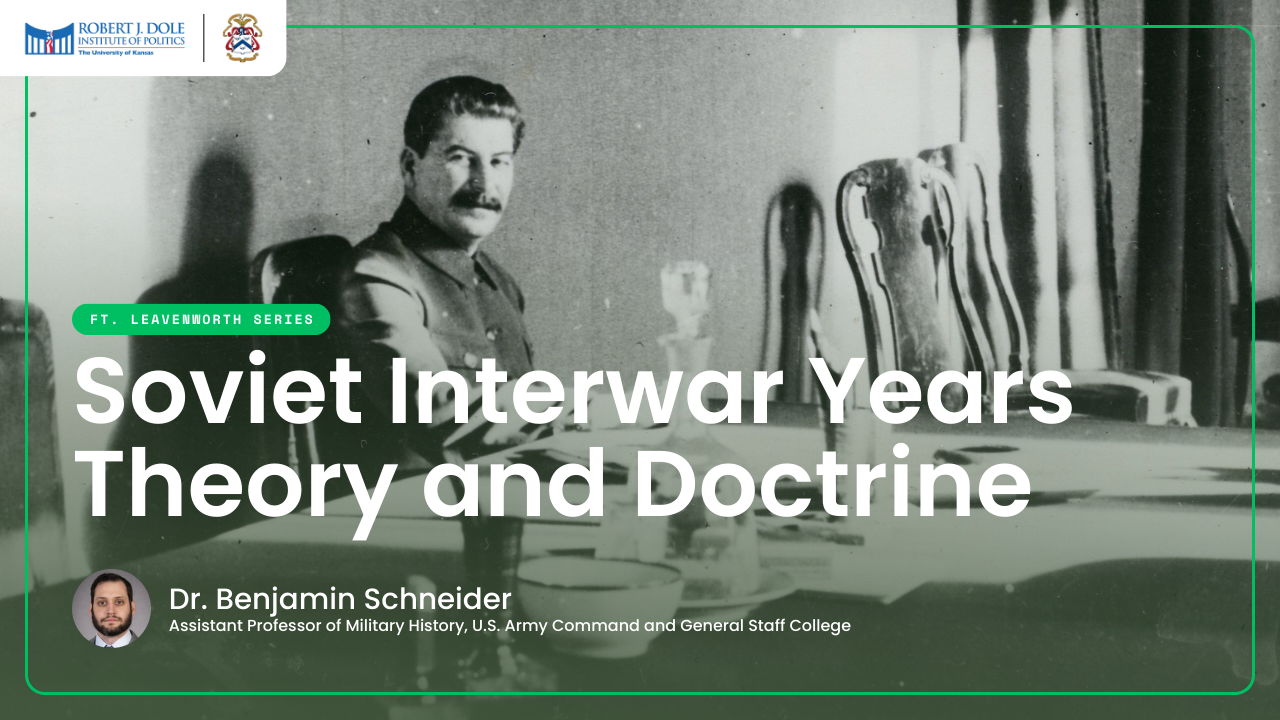
The First World War brought enormous changes to the battlefield that all combatants struggled to master. After the war’s end, military officers began to try to understand what would be needed to succeed in the next war, in the Soviet Union no less than anywhere else. While the Red Army has been often seen as thoughtless, throwing men relentlessly into the meatgrinder of combat, its officer developed one of the most sophisticated understandings of what modern war would entail in the period between the wars, setting them up for success against the eventual German invasion. This talk examines Soviet doctrine in the interwar period, how it outthought and outfought its German adversary, and how it made significant contributions to modern military theory.
Benjamin M. Schneider is an assistant professor in the Department of Military History at the U.S. Army Command and General Staff College. He has held fellowships at the U.S. Naval War College, the Harry Frank Guggenheim Foundation, and the U.S. Army Center of Military History. He received his doctorate from George Mason University in 2019, and his research has appeared in The Journal of Contemporary History and War In History. His book American War Crimes in the Second World War: The Failure of Military Justice is forthcoming with Oxford University Press.
The Ft. Leavenworth Series is an annual roster of lectures focusing on significant historical events, usually with an emphasis on military history. Each lecture is presented by faculty from the United States Army Command and General Staff College in Ft. Leavenworth, Kansas. Established by General William Tecumseh Sherman in 1881, the CGSC is the graduate college for U.S. Army and sister service officers. The esteemed faculty and guests of the CGSC provide unique and captivating insights into the history of military conflict from the ancient to the modern ages at the Dole Institute of Politics.
The opinions expressed herein are those of the individual and do not necessarily represent the views of the U.S. Army Command and General Staff College or any other governmental agency.