U.S. Strategy and Sherman’s Savannah Campaign
September 2 @ 3:00 pm - 4:00 pm
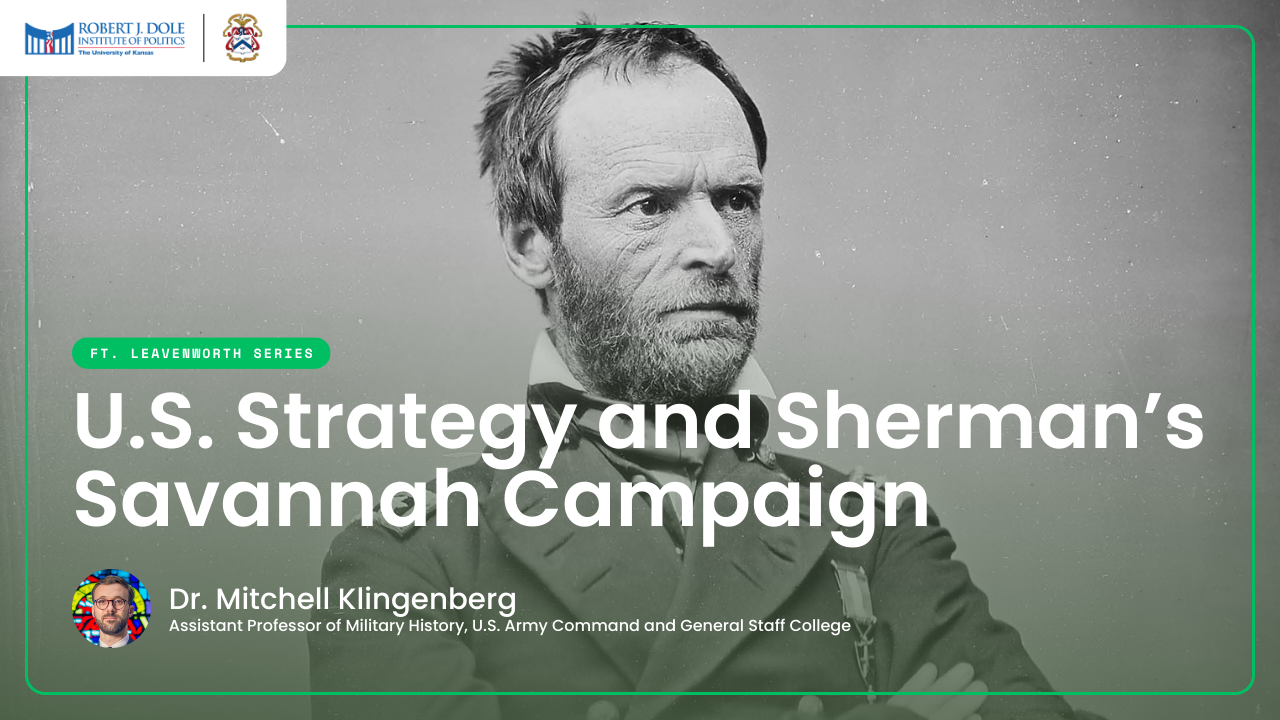
Perhaps the most memorable campaign that underpinned US Army LTG Ulysses S. Grant’s military strategy of 1864, MG William Tecumseh Sherman’s Savannah Campaign exhausted the Southern Confederacy and hastened an end to the American Civil War. The “March to the Sea” has inspired mixed mythologies of the war: it became synonymous in the Lost Cause with devastation and destruction, a misleading interpretation that has proven resilient even in US military circles. In point of fact, Sherman’s campaign was restrained in its conduct despite achieving lasting and significant effects, foremost among them, the destruction of racial slavery in the United States.
Mitchell G. Klingenberg is an assistant professor in the Department of Military History at the US Army Command and General Staff College. Previously, he served on the faculties of the United States Military Academy at West Point and the US Army War College. He is the author of numerous articles and reviews, a monograph on the China Campaign of 1900, and shorter pieces of military history. His writings have been published in numerous venues, including American Nineteenth Century History, Civil War History, The International Journal of Military History and Historiography, the Modern War Institute at West Point, and War on the Rocks.
The Ft. Leavenworth Series is an annual roster of lectures focusing on significant historical events, usually with an emphasis on military history. Each lecture is presented by faculty from the United States Army Command and General Staff College in Ft. Leavenworth, Kansas. Established by General William Tecumseh Sherman in 1881, the CGSC is the graduate college for U.S. Army and sister service officers. The esteemed faculty and guests of the CGSC provide unique and captivating insights into the history of military conflict from the ancient to the modern ages at the Dole Institute of Politics.
The opinions expressed herein are those of the individual and do not necessarily represent the views of the U.S. Army Command and General Staff College or any other governmental agency.