Looking back on Sen. Bob Dole’s farewell to the U.S. Senate
June 11, 2026 - Features
by Kerry Tymchuk | Speechwriter for Sen. Bob Dole and member of the Dole Institute Board of Advisors
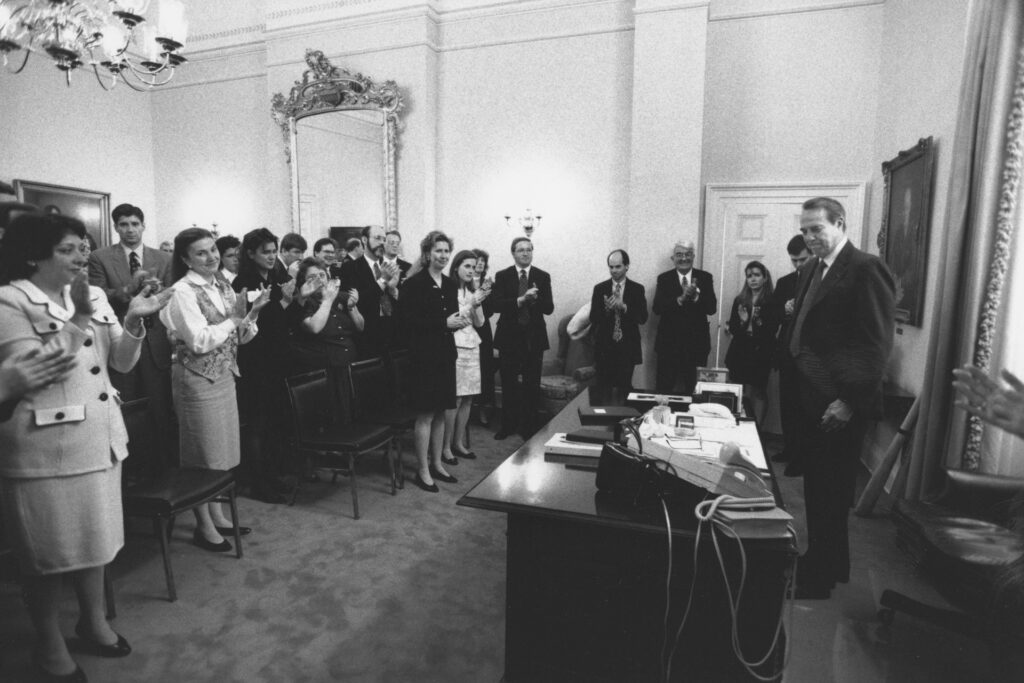
As Senator Bob Dole addresses his office staff on June 11, 1996, Kerry Tymchuk (fifth from right), one of Dole’s speechwriters, listens on. Photo by P.F. Bentley, housed in the Dole Photograph Collection, Robert and Elizabeth Dole Archives and Special Collections.
Thirty years ago today, Senator Bob Dole stood at the Majority Leader’s desk in the Senate Chamber to deliver his final remarks as a member of the United States Senate. Dole had announced weeks earlier, after securing the delegates that ensured he would be the Presidential nominee of the Republican Party, that he would be resigning from the Senate to devote his full attention to his campaign against President Bill Clinton.
I had spent the past month working with Senator Dole to hone and finalize his remarks. Of the hundreds upon hundreds of speeches on which I had the honor of working with him, I could sense these were the ones that meant the most to him, and the ones on which we spent the most time in preparing.
Three decades later, they stand as testimony to Senator Dole’s character and leadership, and as a counterpoint and antidote to the hyper-partisan bitter atmosphere that has come to dominate today’s political scene.
In our very first meeting to discuss the speech, Senator Dole gave me two very specific instructions. First, in no way should his remarks be seen as a campaign speech. His focus was on sharing memories of his over twenty-seven years as a Senator, not on the next five months leading up the November election. And second, it was clear to him that any success he had as a Senator and as Republican Leader was achieved because of the atmosphere of trust, mutual respect, and bipartisanship.
The remarks he delivered were full of praise for his Democrat colleagues past and present: his partnership with George McGovern on expanding nutrition programs; his teaming up with Daniel Moynihan to save Social Security; his work with Ted Kennedy and Tom Harkin to pass the Americans with Disabilities Act. (When I sent a draft of the speech with the managers of his presidential campaign, they sent instructions back to remove all praise of Democrat Senators. When I shared that request with Senator Dole, he told me to ignore it and to not send them any more drafts.)
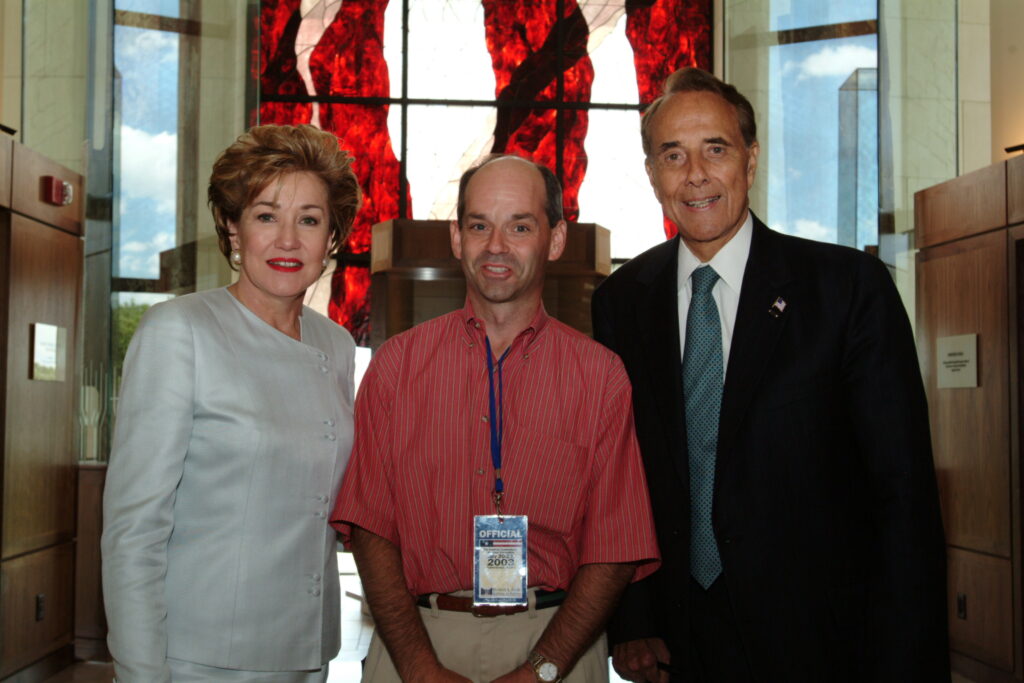
Kerry Tymchuk with Senators Elizabeth and Bob Dole at the Dole Institute’s dedication ceremonies on July 22, 2003. Records of the Dole Institute of Politics, Robert and Elizabeth Dole Archives and Special Collections.
In his remarks, Senator Dole also saluted those who were sitting in the Senate’s press gallery, saying, “I think it’s fair to say that we didn’t always agree with everything you said or write, but I know that what you do off this floor is as vital to American democracy as anything we do on it, and we have to keep that in mind.” What a contrast to those who accuse the press of being the “enemy of the people.”
Senator Dole also cast his eyes beyond America’s shores, reflecting on the number of foreign leaders who, since the fall of the Berlin Wall, had come to Capitol Hill not in search of money, but in search of inspiration. He reminded us that America “Is more than a place on the map…We’re a beacon of hope. We’re a magnet for the oppressed and a shield against those who would put the soul itself in bondage.”
As he neared the conclusion of his remarks, Senator Dole would remind his colleagues that the ultimate goal of public service was not any personal glory, saying, “When they catalogue all the amendments and all the bills and do all the commentary, is that whenever it’s all over for us here,” what truly mattered was what “we’ve left our children.”
Although he lost the Presidential election that November, Senator Dole would continue to speak out for another quarter-century—until his passing on December 5, 2021—on the points he highlighted in his Senate farewell speech, most often and most especially on the need for civility and bipartisanship.
And in his farewell letter to the American public, released by his family upon his passing, Senator Dole would would again look forward and not back, writing that his final words were those that he personally heard his hero and fellow Kansan, Dwight Eisenhower, used to conclude his 1952 Presidential campaign kick-off speech in Abilene, Kansas: “I believe in the future of the United States of America.”

Kerry Tymchuk has served as Executive Director of the Oregon Historical Society (OHS) since 2011. Based in Portland and featuring a world-class museum and research library, OHS is the designated steward of Oregon’s history. A graduate of Willamette University and Willamette University School of Law, Kerry had a 25 year public service career before assuming the helm at OHS. His career includes service as a Marion County Deputy District Attorney, Director of Speechwriting to U.S. Secretary of Labor Elizabeth Dole, Director of Speechwriting and Legal Counsel to Senator Bob Dole, and Oregon Chief of Staff to United States Senator Gordon Smith. He has also co-authored four books with Senators Bob and Elizabeth Dole. A four-time champion on the popular television game show Jeopardy, Kerry and his wife, Becky, reside in Beaverton, Oregon, and are the parents of a daughter and a son.
About the Dole Institute
The Dole Institute of Politics promotes a new era of leadership that uses politics to bring people together through opportunities that emphasize bipartisan cooperation, public service, and civic education and engagement, inspired by the leadership legacies of Senators Bob and Elizabeth Dole and the enduring civic contributions of the Greatest Generation.
The Dole Institute is committed to universal accessibility in all programs and resources. We are in the process of making all of our web projects fully accessible. An accessible version of the material represented on this site will be made available upon request. Please contact us at doleinstitute@ku.edu to request the material be made available in an accessible format, or for general assistance.